Get In touch
Feel free to email me at hi@riteshr.com.np for counsuting work, and I'll get back to you.
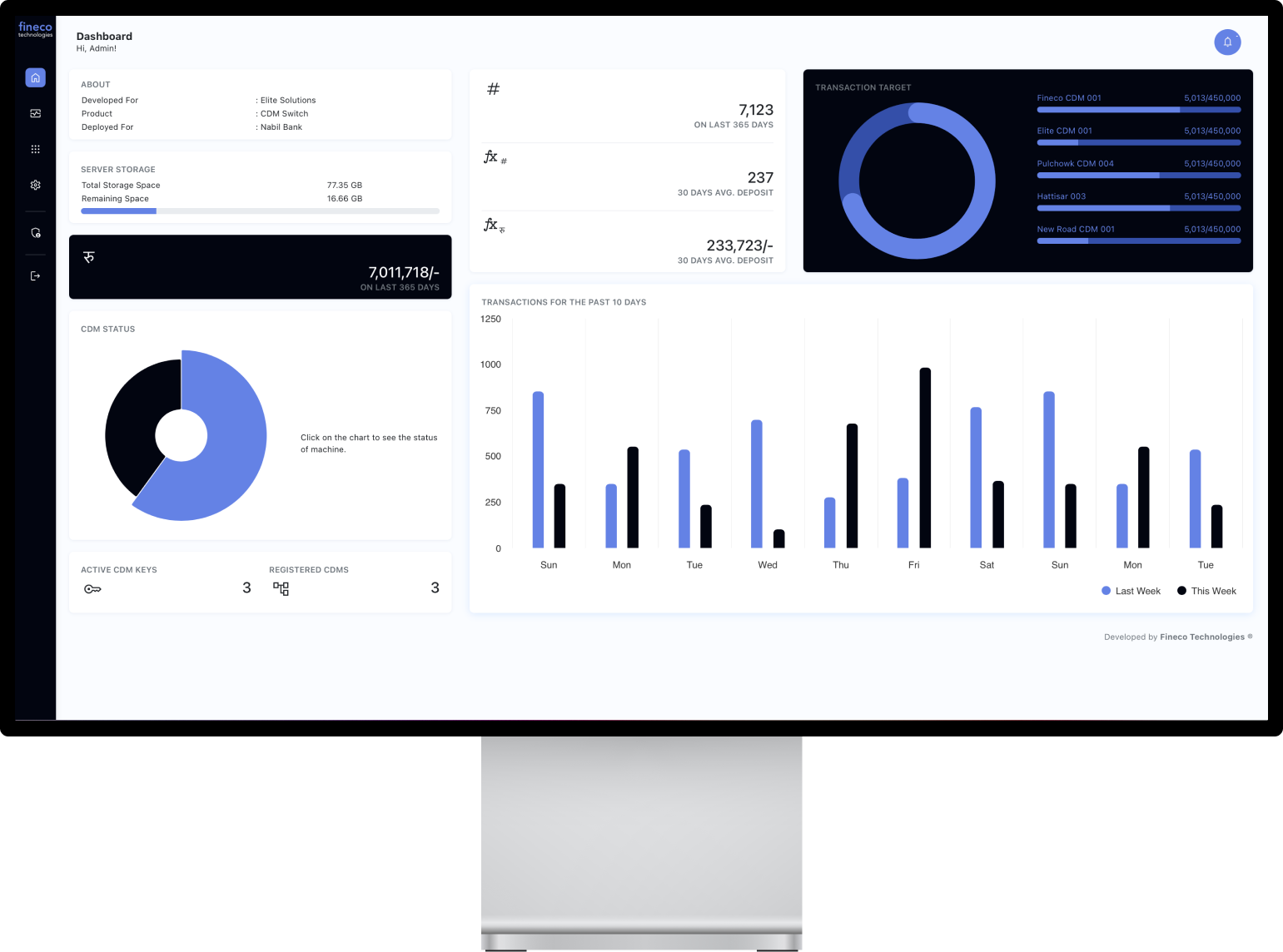
A switch platform built to connect a bank's entire fleet of Cash Deposit Machines (CDMs) into a single system — giving banks real-time visibility into machine health, centralized control over on-screen content, and a unified, auditable record of every deposit transaction across every branch.
The system was built to address a problem that grows with every machine a bank deploys: a CDM isn't just a device, it's a small, physically distributed piece of infrastructure — and a fleet of them, spread across branches, is only manageable if someone can see all of it, at once, from one place.
Banks deploying CDMs as part of their self-service channel expansion face a problem that scales badly with success: every machine added to the fleet is another physical device that can jam, run low on cash, go offline, or need attention — and every one of them is sitting in a different branch, unattended, often outside normal banking hours.
Without a centralized system, "is the CDM in Macquarie working right now?" is a question that requires someone physically checking, or waiting for a customer complaint. Machine status, deposit reconciliation, and content updates (like on-screen advertisements) all lived as separate, manual, branch-by-branch problems rather than something the bank could see and act on centrally.
At the same time, every CDM deposit is a financial transaction that needs the same rigor as any other channel — logged, traceable, tied to a customer, and secured — while the CDM itself is a physical machine that needs its own operational monitoring layer on top of that.
The core challenge wasn't building a dashboard — it was building a switch that could sit between a distributed fleet of physical machines and the bank's systems, handling real-time device monitoring, transaction processing, and remote content management as one coherent platform instead of three disconnected tools.
This meant the system needed to:
In effect, the system needed to function less like a device dashboard and more like an operations and transaction switch, with monitoring, content management, and financial logging all routed through it.
I was responsible for the architecture and development of the platform, with ownership spanning device monitoring, transaction logging, content management, and security.
My work included:
The key architectural responsibility was making sure that no matter how many clients sat under a fund manager, a single trade decision reached every account correctly and with minimal delay — and that every account's accounting stayed accurate even when a trade didn't go through as planned.
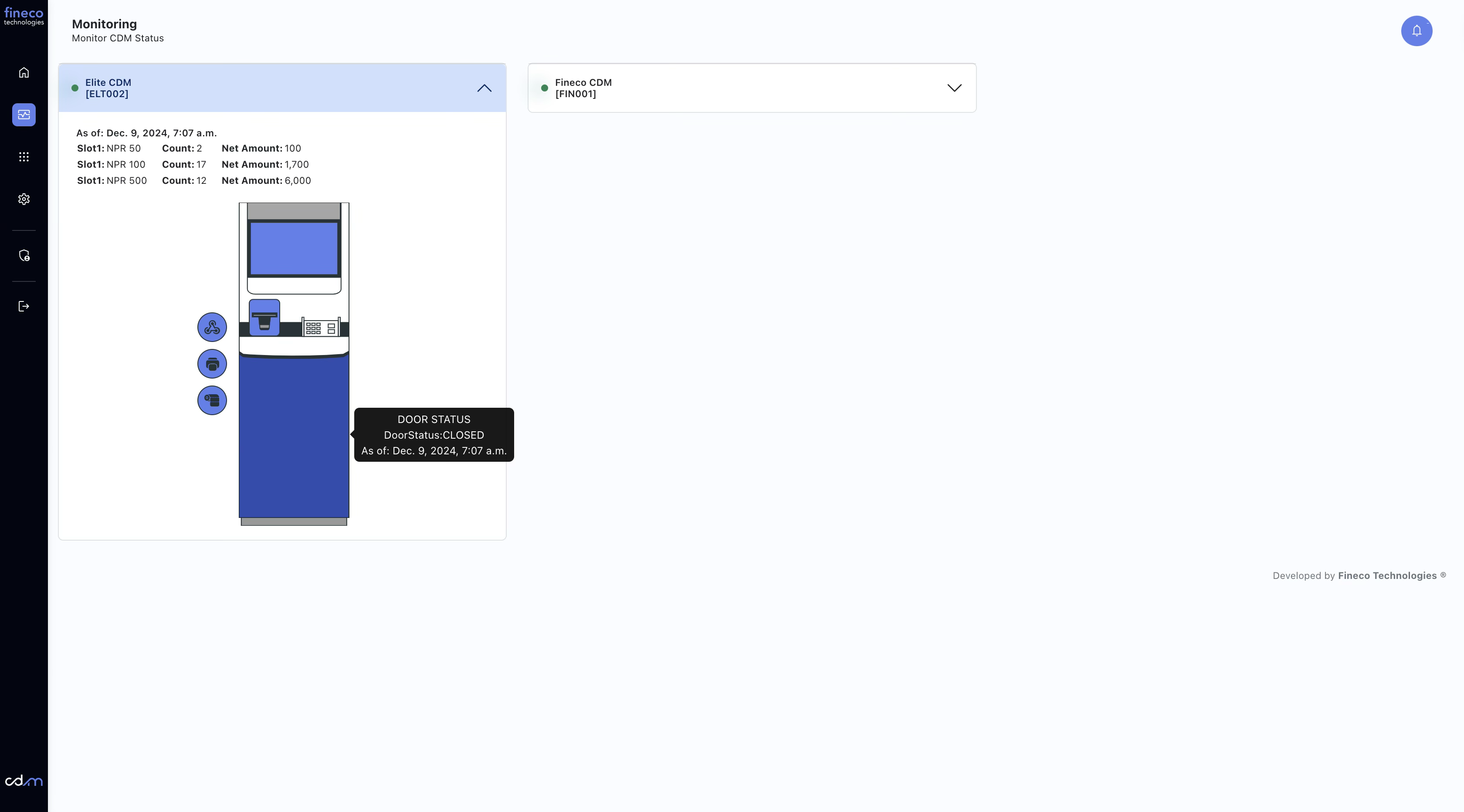
The core difficulty wasn't monitoring one machine — it was aggregating live status from every machine in a fleet spread across branches into one coherent, real-time view, without that view lagging behind what was actually happening on each device. That meant the monitoring layer had to reliably ingest and reflect device-level state changes as they happened, machine by machine, without any one device's issue affecting visibility into the rest of the fleet.
An abnormal machine state that only surfaces when a customer complains or an admin happens to check is already too late. Building automated alerting meant the system had to recognize an abnormal condition — out of service, out of receipt paper, door issues — and notify the right people immediately, without requiring anyone to be actively watching a dashboard for it to work.
A deposit transaction record on its own doesn't tell an operator everything they might need during an investigation or dispute. Extracting photos captured during the transaction and reliably mapping them to the correct transaction record — rather than leaving that correlation to be done manually — meant the transaction and content-capture pipelines had to stay tightly synchronized, machine by machine.
Updating advertisements or branding on one machine is trivial. Doing it consistently and correctly across an entire fleet, remotely, without requiring anyone to touch a machine physically or configure it individually, meant building content distribution as a genuine fleet-wide push mechanism — with validation on format and ratio built in, since a bad upload shouldn't be able to break the display across every CDM in the network at once.
A CDM switch isn't just handling data — it's tied to cash-handling machines and real deposit transactions, which meant the security bar had to match what's expected of core financial systems: 2FA, end-to-end encryption, DSS compliance, and a full audit trail capturing who viewed or modified what, and from where. Layering that consistently across monitoring, transactions, and content management — rather than only around the transaction data — was a deliberate design decision, not just a compliance checkbox.
This project changed how I think about systems that sit at the boundary between physical infrastructure and financial data. It's tempting to treat device monitoring and transaction processing as separate problems — one is operational, one is financial. In practice, for something like a CDM, they're the same problem viewed from two angles: a machine going out of service and a deposit needing investigation both trace back to the same physical device, at the same branch, at the same moment.
The real engineering work was building a switch that didn't force a choice between those two views — one platform that could tell an admin both "this machine needs attention" and "here's exactly what happened on it," without those being two different systems that had to be manually cross-referenced. That's the lens I bring to any system that has to manage both the physical and financial sides of the same infrastructure.
Feel free to email me at hi@riteshr.com.np for counsuting work, and I'll get back to you.